


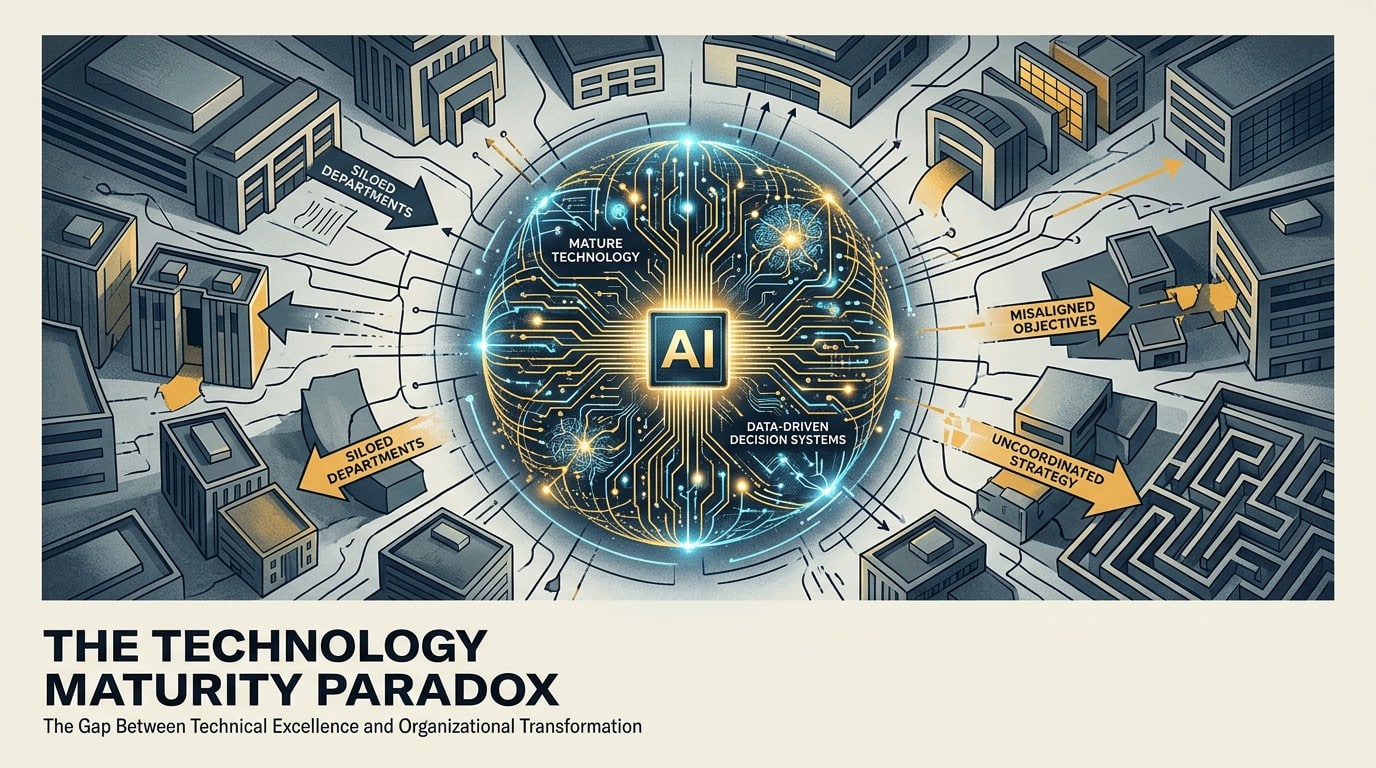
Many organizations are investing heavily in AI but are still not seeing the major changes they hoped for. This article is about why good technical knowledge is not enough to transform an organization. AI can make work faster and easier, but to create greater value, organizations also need to change how they are led, make decisions, and collaborate. When goals, responsibilities, and drivers are moving in different directions, technology alone cannot solve the problems. The article highlights the difference between improving existing working methods and rethinking from scratch. It also highlights the need for common goals and better collaboration, both within and between organizations. The main message is simple: To get more benefit from AI, organizations must develop their ability to change together, not just their ability to use new technology.
Technological maturity paradox: Why AI does not deliver the transformation that executives expect
Table of contents in this article
In recent years, artificial intelligence has gone from being a futuristic issue for technology departments to becoming a strategic issue for boards of directors, management teams, and public decision-makers. At the same time, as investments in AI increase at a rate unparalleled in history, a certain frustration is also emerging among many business leaders, who despite significant investments still do not see the profound effects on business models, productivity, and societal development that were often promised when the AI wave took off.
In an article in the magazine Computer Sweden (CEOs have had enough of small AI advancements) This frustration is highlighted by a survey from Avanade, where a large proportion of the decision-makers surveyed believe that AI investments too often lead to limited improvements rather than real transformation. At the same time, several analysts believe that the problem does not necessarily lie in the technology but in how organizations choose to use it. This is where a more fundamental question begins to emerge. Perhaps it is not the AI that is developing too slowly. Perhaps it is the ability of organizations to change themselves that is developing too slowly.
When the map is confused with reality
In conversations with leaders from both the public and private sectors, a near-universal theme emerges. pattern. Almost every organization describes itself as technologically mature, and many also consider themselves leaders or even pioneers in one or more technological disciplines. The descriptions are often sincere and often based on actual successes in areas such as data management, cybersecurity, digitalization, automation, or AI.
The problem arises only when these successes begin to be used as indicators of something much larger than they actually represent. People tend naturally to generalize from the area they know best. Therefore, when an area of activity functions well, there is a risk that the organization begin to assume that the same maturity permeates other parts of the business as well. A successful AI initiative can then create a sense that the organization as a whole is transformative, even though the ability to lead change, build collaboration, or coordinate complex initiatives may still be limited.
In this way, a situation arises where the map begins to become confused with reality. The part of the business that is visible, functioning well, and easy to measure gets to represent the whole, despite the fact that large parts of the organization’s actual capacity lie outside the technical domain. The result is that technological maturity gradually begins to be perceived as organizational maturity, despite these two concepts describing fundamentally different phenomena.
Technological maturity is not the same as the ability to transform
The confusion between technological maturity and transformational capability is likely one of the most underestimated reasons why many AI initiatives yield less impact than expected. Technological maturity essentially refers to an organization’s ability to develop, implement, manage, and use technology. It encompasses factors such as expertise, architecture, security, data management, integration capabilities, and technological platforms. These are important capabilities, but they say very little about the organization’s ability to change itself.
Transformational capability, on the other hand, is about something much broader. It encompasses leadership, governance, strategic coordination, culture, incentive structures, decision-making processes, and organizational learning. These are the mechanisms that determine whether new technology is actually translated into changed behaviors, new working methods, and long-term value creation. The difference can be illustrated by noting that it is often significantly easier to implement a new technological system than to change people’s ways of collaborating around the system. Moreover, it is easier to invest in technology than to change goal structures, division of responsibilities, and organizational norms.
Many organizations therefore manage to become very skilled at introducing technology while remaining relatively immature when it comes to changing the structures within which the technology operates.
A meeting with one hundred technology-savvy organizations
This paradox became particularly evident at a larger collaboration meeting with about a hundred participants from organizations involved in extensive and capital-intensive development projects. Almost all the participants described their respective organizations as technically mature. Several considered themselves to be at the forefront of digitalization and advanced technology development. On the surface, therefore, all the prerequisites existed for creating effective forms of collaboration around some of the most strategically important development issues. But the longer the discussions continued, the more evident it became that the participants had very different perceptions of what collaboration actually meant.
For some, collaboration meant information exchange between actors. For others, it meant joint investments or shared responsibility. Some saw it as coordinating activities, while others considered collaboration as a tool for joint innovation. Although collaboration formed the very foundation of the projects, a common understanding of the concept was lacking. What was therefore visible in the room was not technical limitations but organizational limitations. The difficulties lay not in the technology, but in the ability to create shared perspectives, shared goals, and shared responsibility.
The paradox thus becomes difficult to ignore. If high technological maturity were truly an expression of high organizational maturity, then precisely this type of fundamental coordination problem should be relatively rare. However, experience shows that it is very common.
Moral hazard in digital interactions
When large development initiatives involve several organizations, another mechanism becomes visible, namely what within the national economy is commonly described as moral hazard. The concept implies that an actor can influence a collective outcome without fully bearing the consequences of their own decisions. The phenomenon often occurs in situations where responsibility, risk, and reward are unevenly distributed between different parties. In many collaborative projects, all actors express support for the common goal. At the same time, each organization naturally operates within its own mandates, budgetary frameworks, and priorities. This means that incentives tend to pull in different directions even when the ambitions on paper appear to coincide.
The consequence is that in some cases collaboration develops into something that primarily exists in strategy documents, steering group presentations, and visionary goals, while the practical actions in everyday life are governed by local interests and individual calculation of benefits. This creates a situation where technology is expected to solve problems that are fundamentally organizational in nature. When results fail to materialize, attention often turns to the technology instead of the patterns of collaboration that limit its potential.
The AI explosion follows a well-known historical pattern
Although AI appears to be a revolutionary technology, the organizational logic behind today’s challenges is strikingly familiar. History shows that almost every major technological shift follows similar development paths. During industrialization, companies first invested in machines before they learned to organize production around those machines. When ERP systems began dominating business development in the 1990s, many organizations initially focused on the systems rather than on the processes they were intended to support. Similarly, the first wave of digitalization often involved digitizing existing work processes rather than questioning the work processes themselves.
AI is developing today according to the same pattern. In the first phase, the technology is used to streamline existing processes. Documents are summarized more quickly, analyses are produced more efficiently, and administrative tasks are automated. These gains are both real and valuable, but they rarely change the fundamental logic of the business. It is only in the next phase that the real transformation occurs, as the organization then begins to question why the processes exist and whether they should be designed in entirely different ways. It is this transition that many organizations have not yet achieved.
Between optimization and transformation
It is important to distinguish between optimization and transformation because these concepts are often used as if they were synonymous. Optimization is about improving what already exists. Transformation, on the other hand, involves reevaluating the very starting point:
- When AI makes it possible to write reports faster, an optimization occurs.
- When AI leads to the organization rethinking its entire decision-making model, transformation occurs.
- When clerks can handle more cases per day, there has been an increase in efficiency.
- When the business is redesigned based on new ways of creating value, a real transformation can take shape.
The problem is not that organizations focus on optimization. The problem arises when optimization is incorrectly interpreted as transformation, because management then risks believing that the change journey has taken longer than it actually has.
The real bottleneck is rarely the technology
When AI investments do not deliver the expected returns, attention is often directed towards data quality, models, computing power, or technological platforms. These factors can of course be important, but experience shows that the crucial bottleneck is often found elsewhere. It is found in goal conflicts between different departments, unclear mandates, weak collaboration structures, and the lack of common definitions of what should actually be achieved.
Technology is rarely the factor that creates value in itself. Value arises when people, organizations, and processes use technology to achieve something together. When these prerequisites are lacking, the technological potential often becomes severely limited, regardless of how advanced the technology happens to be.
From technical maturity to system maturity
The perhaps most relevant question for management teams in the future is therefore not how technologically mature the organization is, but how systemically mature it is. Systemic maturity naturally encompasses technology, but it also encompasses the ability to build trust among stakeholders, create shared goals, balance incentives, make decisions across organizational boundaries, and learn together in complex environments. As AI becomes increasingly accessible, the technology itself will gradually lose its character of a competitive advantage. What will distinguish successful organizations instead is their ability to create functioning systems where technology, people, processes, and governance work together towards a common purpose.
Only then will AI go from being a tool for streamlining operations to becoming a transformative force.
Summary: The technology maturity paradox
The central lesson from today’s AI debate is that high technological maturity does not necessarily imply high organizational maturity, and that in some cases it can even be the opposite. The more successful an organization is within a limited technological area, the greater the risk that it may overestimate its ability to handle the human, organizational, and institutional dimensions that real transformation requires. It is therefore possible that AI delivers exactly what the technology promises while organizations experience growing frustration. Expectations are often about transformation, whereas investments in practice primarily create optimization. The technology maturity paradox thus lies not in the fact that technological development is going too slowly, but in the fact that organizations all too often interpret technical proficiency as evidence of systemic capability.
The real challenge, therefore, is not to make artificial intelligence work better – the real challenge is to get organizations to work better together.
Read the analysis article about low AI implementation in Computer Sweden>

