



Solutions for coordinated information systems
The root problem is often not the individual IT systems themselves, but the lack of a common governance of information, clear data ownership, and a cohesive information architecture. The organization has gradually built up a complex system landscape where ERP, CRM, BI systems, logistics systems, and Excel-based solutions create multiple versions of the truth. When the same information is defined, recorded, and processed in different ways, conflicting reports, time stamps, manual reconciliations, and uncertainty arise regarding which data should form the basis for decisions. The consequences are felt throughout the entire organization: administration increases, data quality deteriorates, and the reliance on individual employees” knowledge becomes greater. At the same time, fragmented identity and access management complicates information security and compliance efforts. Local solutions may be beneficial for a department, but they exacerbate the problems when they lack connection to common definitions, processes, and responsibilities. The solution therefore needs to be broader than new systems or additional technical integrations. The starting point is to treat information as a strategic asset owned by the business, while IT is responsible for the technical environment. Through shared information governance, designated information owners, and standardized concepts, the organization can create a stable foundation for master data, reporting, and follow-up. In the short term, the work involves clarifying responsibilities, mapping information assets and shadow systems, and coordinating key metrics and access management. In the longer term, this needs to be developed into a common information model with centralized master data management, traceability, and ongoing quality controls. The goal is an established ”Single Source of Truth” that strengthens trust in the decision-making basis, reduces duplication of effort, and makes the information usable across organizational boundaries. The change should be driven as a company-wide transformation program, with clear leadership responsibility and close collaboration between operations and IT, rather than as a separate technology project without a shared foundation in the business.
Noted rotor issues:
- Unclear data ownership.
- Inadequate Master Data Management (MDM).
- Excel as an informal shadow system.
- Fragmented identity and entitlement management.
- Deficient information architecture.
- Local business optimization that counteracts common information models.
Consequences for the business:
- Different reports show different KPI values.
- High administrative burden.
- Increased personal dependence.
- Impaired data quality.
- Low confidence in decision-making processes.
- Unnecessary security and compliance risks.
- Reduced productivity and increased frustration among users.
Desired location:
A common information model where the business owns the information, IT is responsible for the systems, and the organization works based on an established ”Single Source of Truth”.
Knowledge areas that are required or need to be utilized
| Area | Why it is needed |
| Data Governance | Define ownership, rules, responsibilities, and data quality |
| Enterprise Architecture | Create architectonic design for the system landscape |
| Master Data Management (MDM) | Establish a common version of customer, product, and supplier data |
| Information architecture | Standardize information objects and conceptual models |
| Information security | Ensure proper authorization and data protection |
| Identity and access management (IAM) | Reduce problems with multiple identities and permissions |
| Change management | Ensure operational alignment |
| Process development | Adapt processes to a common information model |
| Business Intelligence & Analytics | Consolidated reporting and KPI management |
| GDPR and regulatory compliance | Management of personal data and master data |
Additional competencies that should be acquired:
- IAM specialists
- Business systems architects
- Data Governance specialists
- Information architects
- Integration architects
Proposal for a solution in the short term
Step 1: Establish Data Governance. Management should make a formal decision that information is a strategic asset. Create:
- Data Governance Board
- Information Sharing Forum
- Common decision-making processes for data definitions
Examples of information owners according to the article:
| Information | Business owners |
| Customer data | Sales Manager |
| Supplier data | Purchasing Manager |
| Product data | Product manager |
| Logistics data | Supply Chain Director |
| Financial data | CFO |
| Personal data | Human Resources Director |
Step 2: Invent the information objects. Identify:
- Customer
- Supplier
- Product
- Employee
- Organization
- Order
- Invoice
For each object, the following is documented:
- System source
- Owner
- Definition
- Quality
- Integrations
The result will be an information register.
Step 3: Stop the growth of shadow systems. Conduct an inventory of:
- Excel-based reports
- Access databases
- Local BI solutions
- Manual databases
Prioritize the 20 % that generate 80% % of the decision-making material. Consolidate these into common reporting platforms.
Step 4: For Single Sign-On. Consolidate identity management. Recommended platforms:
Goal:
- One identity per user
- Centralized authorization control
- Multifactor authentication
Step 5: KPI standardization. Create a KPI library where definitions are decided centrally. Example:
| KPI | Definition |
| Delivery precision | Same definition in all systems |
| Turnover | Same data source and calculation |
| Customer activity | The same business rule |
Proposal for a long-term solution
Vision: An information-driven organization. The organization should move from system-centric control to information-centric control.
Architectural principles
- Information belongs to the business.
- The systems are interchangeable.
- Master data is managed centrally.
- Integrations are standardized.
- KPIs are defined centrally.
- One identity per individual.
Architectural design
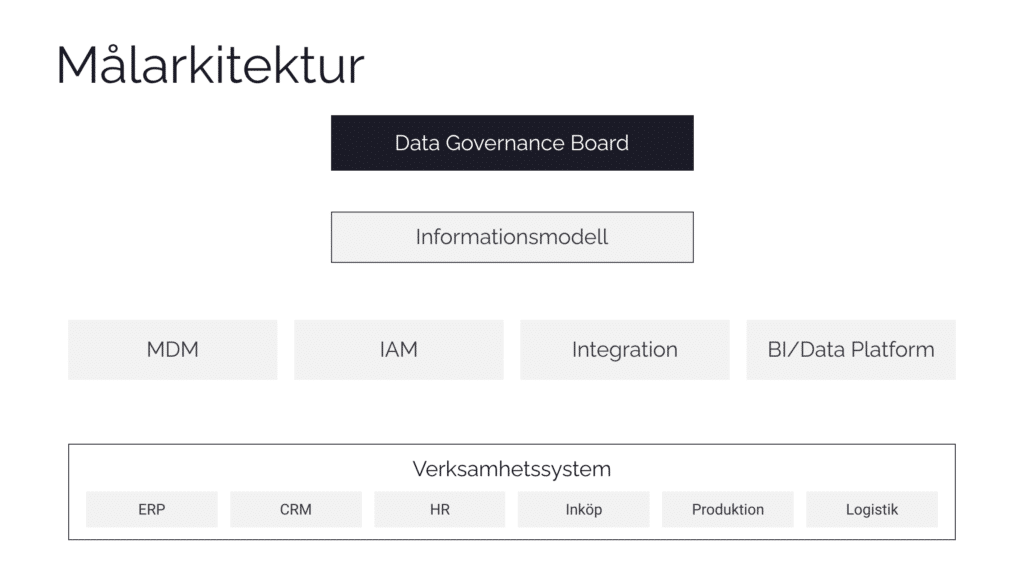
MDM platform
Towards a central Master Data Management solution. Examples:
- SAP Master Data Governance – Read more
- Informatica MDM – Read more
- Semarchy – Read more
- Microsoft Fabric + Purview – Read more about Fabric | Read more about Purview
- IBM InfoSphere – Read more
Purpose:
- Unique customer number
- Unique product numbers
- Common organizational structure
- Data quality controls
Data Catalog and Metadata
Implement:
Advantages:
- Traceability
- Clear definitions
- Data quality measurement
- Regulatory compliance
Information-driven governance model
Management regularly follows up:
- Data quality
- Master data errors
- Discrepancies in eligibility
- Number of local shadow systems
- Share of standardized KPIs
Responsibility and Drive (RACI)
| Activity | CEO | CoS | CFO | CIO/IT Chef | Business managers | Data Steward |
| Decision on Data Governance | A | R | C | C | C | I |
| Define information owners | A | R | C | C | R | I |
| Master data strategy | C | R | C | A | C | R |
| Information model | I | A | C | R | C | R |
| Authority control | I | C | I | A | C | R |
| KPI standardization | C | R | A | C | C | R |
| Data quality monitoring | I | A | C | C | R | R |
| Reporting to management | C | A | R | C | C | I |
Explanation
- A = Accountable
- R = Responsible
- C = Consulted
- I = Informed
The Chief of Staff should serve as a coordinating force between operations, the management team, and IT.
Need for consultants
| Area | Mission | Action |
| Information architecture | Development of architectural design | 3–6 months |
| Data Governance | Establish a governance model | 2–4 months |
| MDM specialist | Introduction of master data management | 4–12 months |
| IAM specialist | Consolidation of identities | 2–6 months |
| Change leaders | Introduction and operationalization | The entire program |
| Integration architect | Standardizing the integration landscape | 3–9 months |
The consultants should work on clear knowledge transfer to internal roles to avoid long-term dependency.
7. Summary and short action plan
| Priority | Action | Responsible | Time horizon | Results |
| 1 | Establish Data Governance Board | CEO / CoS | 0-2 months | Clear governance |
| 2 | Appoint an information owner | Management team | 0-2 months | Clearly defined responsibilities |
| 3 | Mapping master data and information objects | CIO + Operations | 1-4 months | Transparency |
| 4 | Inventing the Excel and shadow systems | CIO | 1-4 months | Reduced complexity |
| 5 | Standardize KPI definitions | CFO + CoS | 2-6 months | Common decision-making documents |
| 6 | Introduce centralized identity management | CIO | 3-9 months | Higher security and usability |
| 7 | Implement the MDM platform | CIO + Business Owner | 6-18 months | Single Source of Truth |
| 8 | Implement data catalog and metadata management | CIO | 6-18 months | Traceability and quality |
Recommendation: Don’t turn this into an IT project. Treat it as a company-wide transformation program where the management team owns the information issues and IT enables them technically. It directly addresses the root issues identified in Business Problems: Information Systems and creates the prerequisites for a sustainable ”Single Source of Truth”.
Read more about prioritization->

