



The organizational dashboard is a practical tool for understanding and adjusting how an organization functions. It also creates an overview of ”hygiene factors” that create a healthy organization. By seeing structure, governance, culture, competencies, technology, and collaboration as controls, it becomes easier to identify imbalances and choose the right interventions. Instead of seeking a universal solution, management can adapt the organization’s working methods to the mission, development phase, and changing requirements. For a Chief of Staff, the model creates a common language for dialogue, prioritization, and decision-making. It also helps to highlight how a change in one area affects the whole. The article presents the different parts of the dashboard and shows how they can be used to analyze the current situation, detect friction, and design a more effective organization. When controls are consciously balanced, the conditions for clarity, interaction, and implementation power increase, while the organization retains the flexibility required to meet new opportunities and challenges. The result is a concrete basis for direction, ongoing learning, and sustainable organizational development over time.
There is no universal and stable list of exactly 200 requirements that apply to all organizations. The number varies greatly depending on the industry, jurisdiction, organizational form, size, and operations. A bank may have several thousand regulatory requirements, while a smaller consulting firm may have 50-100 directly relevant requirements.
The organizational mixing board
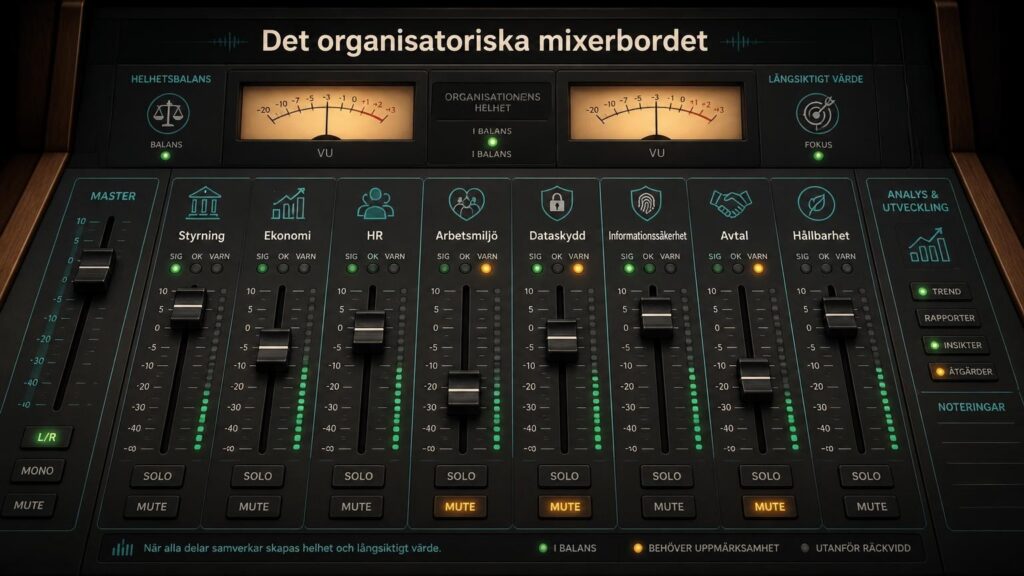
How management teams can balance approximately 200 regulatory, legal and operational critical requirements
Brief
Modern organizations operate in a complex environment where a large number of laws, regulations, standards, agreements, policies, and stakeholder requirements simultaneously influence operations. A medium-sized organization may in practice be affected by hundreds of areas of requirement, each with its own risks, obligations, and consequences of non-compliance. Despite this, many management teams focus only on a limited number of issues at a time. Information security may become the big issue of the year. Next year, sustainability or AI will be at the center of attention. At the same time, other areas risk receiving very little attention, despite the fact that they still pose significant business risks.
This article introduces the concept The Organizational Mixer Table, The model compares the management’s priorities with the mixing console in a professional recording studio. Just as a sound engineer must balance hundreds of audio channels without completely turning off any critical signal, management must continuously balance the organization’s overall demand picture. The basic thesis is simple:
Risk does not arise primarily because the organization prioritizes certain requirements higher than others. Risk arises when management loses awareness of which requirements no longer receive sufficient attention.
För att en organisation ska kunna uppnå en stark, trovärdig och långsiktigt hållbar position på dagens konkurrensutsatta marknad är det helt avgörande att dess interna självbild harmonierar väl med hur omvärlden faktiskt uppfattar densamma. För att denna avgörande balansräkning mellan identitet och anseende ska anses vara fullkomligt sund och intakt, krävs det att verksamheten systematiskt uppfyller en rad högt ställda krav gällande både transparens, etiskt agerande och samhällsansvar. Detta innebär i praktiken att företaget eller institutionen inte bara måste leva upp till sina egna uppsatta visioner och interna värderingar, utan dessutom kontinuerligt måste motsvara de ständigt växande förväntningar och krav som ställs av externa intressenter såsom kunder, samarbetspartners, media och samhället i stort.
The 200 requirements of the organizational mix board
Below is a reference model with 20 main areas and approximately 200 representative requirements.
A. Corporate Governance and Governance (1-10)
- Board responsibility
- CEO instruction
- Work procedures
- Delegation arrangement
- Internal control
- Risk management
- Rule compliance
- Ethical code
- Whistle blowing system
- Ass abuse
Risk of negligence: management deficiencies, liability risks, loss of trust.
B. Accounting and financial reporting (11-25)
- Accounting Act
- Annual report
- IFRS
- GAAP
- Internal reporting
- Account reconciliation
- Construction register
- Periodization
- Group financial reporting
- Cash flow reporting
- Audit requirements
- Documentation
- Internal control
- Financial policies
- Archiving
Risk: inaccurate reporting, sanctions, audit remarks.
C. Taxes and VAT (26-40)
- VAT registration
- VAT reporting
- Point taxes
- Employer contributions
- Tax on sources of income
- Transfer pricing
- Tax deductions
- International taxation
- Benefit taxation
- Travel policy
- Representation
- Foreign staff
- Property tax
- Energy taxes
- Tax audit
Risk: tax increases, fines, tax fraud investigations.
D. Labor Law and HR (41-60)
- LAS
- Collective agreements
- MBL
- The Discrimination Act
- Wage survey
- Recruitment procedures
- Introduction
- Competence development
- Dismissals
- Transformation
- Trade union cooperation
- Time reporting
- The Holiday Act
- Vacation legislation
- Work permit
- Expatriate regulations
- Personnel costs
- Personnel security
- Work adaptation
- Rehabilitation
Risk: labor law disputes, damages, conflicts.
E. Occupational health and safety (61-75)
- SAM
- Safety representative
- Risk assessment
- Accident reporting
- Ergonomics
- Chemicals
- Noise
- Psychosocial work environment
- Discriminatory special treatment
- Collaboration
- Crisis preparedness
- Corporate health care
- Security training
- Security patrol
- Workplace environment policy
Risk: accidents, occupational health and safety violations, sick leave.
F. Data protection and privacy (76-90)
- GDPR
- Legal basis
- Register list
- Data processing assistants
- Data protection officer
- Incident reporting
- Consent forms
- Deletion
- Registration extract
- Transfers outside the EU
- Camera surveillance
- Cookies
- Data classification
- Privacy by Design
- DPIA
Risk: sanction fees, privacy incidents.
G. Information security (91-110)
- Information classification
- Authority control
- Logging
- Backup
- Encryption
- Multifactor authentication
- Identity management
- Incident management
- Vulnerability scan
- Penetration tests
- Supplier security
- Security architecture
- Hot analysis
- Continuity planning
- Disaster Recovery
- Security training
- Data protection
- Cloud management
- AI governance
- NIS2 preparedness
Risk: ransomware, data loss, downtime.
H. Contracts and Law (111-125)
- Contract archive
- Contract follow-up
- Commercial agreements
- NDA
- License agreement
- Supplier agreements
- Customer agreements
- SLA
- Warranty conditions
- Dispute resolution
- Power of Attorney
- Procurement terms
- Limitation of liability
- Force majeure
- Legal monitoring
Risk: loss of income, disputes, damages.
I. Business ethics and anti-corruption (126-140)
- Anti-corruption policy
- Mutor
- Gifts
- Representation
- Third-party risk
- Agent networks
- Conflicts of interest
- Whistleblowing
- Due diligence
- Sponsorship agreements
- Donations
- Competition law
- Cartels
- Sanction compliance
- Export sanctions
Risk: fines, criminal investigations, damage to reputations.
J. Sustainability and ESG (141-155)
- Environmental policy
- Climate reporting
- Emissions data
- Waste management
- Energy consumption
- Supplier control
- Human rights
- Child labor
- CSRD
- Supplier audit
- Scope 1
- Scope 2
- Scope 3
- ESG reporting
- Sustainable financing
K-M. Operational activities, quality, purchasing, real estate (156-200)
156-170 Quality management (ISO 9001-related requirements)
171-180 Supplier management and purchasing
181-190 Property, physical security and fire protection
191-200 Crisis management, continuity, disaster preparedness and business recovery
Each such requirement entails a separate risk profile that needs to be monitored even when the focus is temporarily elsewhere.
Summary
The Organisational Mixer Board is a way to understand the real task of management: balancing a complex portfolio of approximately 200 regulatory, legal, contractual, and business-critical requirements. The model is based on five insights:
- Organizations need to meet certain requirements in order for the self-image and the external perception of the organization to be perceived as ”sound”.
- Not all claims can be pursued at the % same time.
- Not all requirements can be ignored.
- The management's task is to allocate attention and resources.
- The greatest risk arises when management loses sight of which requirements are being neglected.
Advantages
- Holistic view of risk.
- Improved control.
- Better priorities.
- Fewer regulatory surprises.
- More efficient resource allocation.
Disadvantages and limitations
- Requires continuous updating.
- Can be perceived as complex.
- Risk of administrative overload.
- Requires clear risk criteria.
Five readiness questions
- Do we have a documented catalog of our most important requirements?
- Does the management team know which requirements currently receive the least attention?
- Can we justify our priorities based on risk and strategy?
- Do we have a common picture of our risk appetite?
- Is there a systematic process that adjusts the mixing board at least quarterly?
Recommendation
Don’t start with 200 requirements. Start by identifying the 30-50 most important requirements for your own organization and visualizing them as controls on an ”organizational mixing board.” When the leadership team sees the entire requirements landscape at the same time, it becomes significantly more difficult to unintentionally let critical risk areas fall to zero.
Read more about organizational theory here->

