



From information hub to organizational operating system
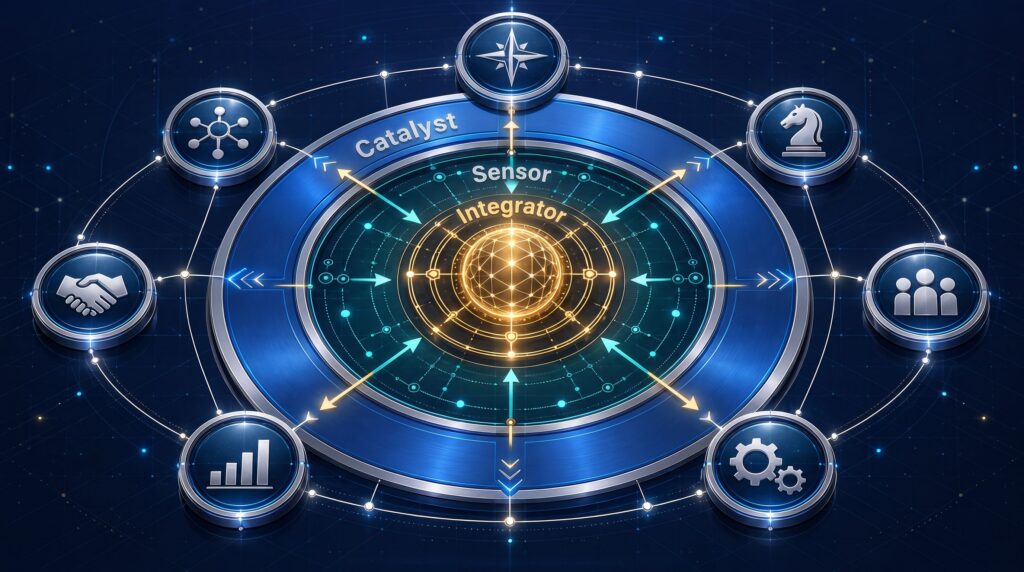
A new view of the Chief of Staff as a function or role
The Chief of Staff is often described as the CEO's right-hand man, the strategic project manager or leadership coordinator. These descriptions capture parts of the role, but miss its true potential. In modern organizations, the biggest challenge is rarely a lack of strategy, initiative, or expertise. The challenge is to discover what is really happening, create context between different perspectives, and translate decisions into organizational capability. This is where a Chief of Staff Operating System comes in. Instead of seeing the Chief of Staff as a separate function, the role can be understood as an operational system for the leadership. A system that helps the organization detect signals, integrate perspectives, and continuously develop its ability to implement strategy. The core of this operational system is built around three complementary roles:
Sensor, Integrator and Catalyst.
Together, they create a coherent cycle where signals become insights, insights become decisions, and decisions become organizational development – a Chief of Staff Operating System where CoS acts as the organization’s sensor, integrator, and catalyst for higher organizational maturity.
The core model
Chief of Staff Operating System can be described as a movement through three questions:
| Role | Core question | Primary focus |
| Sensor | What's happening? | Observation and understanding |
| Integrator | What does that mean? | Context and direction |
| Catalyst | What needs to be developed? | Transition and maturity |
When any of these capabilities is missing, problems arise. An organization without sensors sees changes too late. An organization without integration makes decisions that are not connected. An organization without catalysts gets stuck in the same problems despite good decisions. Therefore, the Chief of Staff does not only serve as support for the management, but also as a link between the organization’s nervous system, decision-making ability, and development capacity.
1. Sensor: Making the invisible visible
The first task of a Chief of Staff is to act as the organization’s sensor. Management teams rarely lack data. However, they often lack the ability to detect weak signals before they develop into larger problems or opportunities. The Chief of Staff therefore needs to create systematic ways to capture information from the entire organization. It’s not just about reports and KPIs – often the most important signals lie between the reports. This can involve:
- recurring frustration between teams
- delays that begin to occur in several initiatives simultaneously
- customer feedback that does not fit the established image
- strategic priorities that are interpreted differently by different parts of the organization
- increasing uncertainty regarding responsibility and mandate
The goal is not to collect more information. The goal is to detect patterns. A strong Chief of Staff does not just look at individual events but can identify underlying system problems before they become visible in the performance reporting.
The question the sensor Always asking questions: What is the organization trying to tell us that we have not yet understood?
2. Integrator: Creating context and direction
About the sensor samlar in signaler är integratörens uppgift att skapa mening. Det är här den största delen av Chief of Staff-arbetet sker. De flesta organisationer lider inte av för få beslut. De lider av för många beslut som inte hänger ihop. Strategin säger en sak, budgeten prioriterar något annat. Ledningsgruppen kommunicerar ett tredje budskap. Verksamheten arbetar med ett fjärde fokus. När detta sker uppstår organisatorisk friktion. Chief of Staff fungerar då som integratör mellan organisationens olika system. Rollen kopplar samman:
- Strategy and implementation
- Management decisions and everyday work
- Short-term delivery and long-term development
- Functions and business areas
- goals, resources and priorities
It’s not about owning the decisions. It’s about ensuring that the decisions form a logical whole. A skilled Chief of Staff helps the leadership see the consequences, dependencies, and goal conflicts before the organization does so.
The question The integrator Always asking questions: How does this tie in with everything else we are trying to accomplish?
3. Catalyst: Building capacity, not dependencies
Many Chief of Staff roles get stuck in operational problem solving. They become the person everyone goes to to get things to work. In the short term, that can be valuable. In the long term, it becomes dangerous. When the organization becomes dependent on individual individuals, its resilience decreases. Therefore, the third and most mature role is the catalyst. The task of the catalyst is not to solve the problems itself. The task is to help the organization become better at solving them. This means that:
- develop the working methods of the management team
- improve the quality of decisions
- create learning loops
- strengthen cooperation across organizational boundaries
- building sustainable structures rather than relying on personal relationships
An organization with strong catalytic capabilities gradually becomes less dependent on the Chief of Staff and at the same time more efficient. Paradoxically, this is often when the role creates the greatest value.
The question the catalyst Always asking questions: How can we strengthen the system instead of solving a single problem?
How the three roles interact
The three roles should not be seen as separate job descriptions. They form a coherent system. The process looks like this in its simplest form:
- The sensor identifierar en signal.
- The integrator sets the signal in a larger context.
- The catalyst helps the organization develop its capabilities based on learning.
- The organization becomes stronger and generates new signals.
- The race starts again.
In this way, the Chief of Staff becomes a facilitator of organizational learning rather than an administrative function.
The seven building blocks of the Chief of Staff Operating System
For the three roles to work in practice, an operating system with seven basic building blocks is needed.
- Mandate and positioning: Clarifies why the role exists, what its mandate is and how it interacts with the CEO, the management team and other functions.
- Signal and sensor systems: Create structures to identify risks, opportunities, tensions, and weak signals in the organization.
- Strategic integration: Connects strategy, priorities, resources, and decisions.
- Management system: Defines meeting structures, decision-making forums, allocation of responsibilities, and follow-up.
- Implementation power: Ensures that strategic initiatives are translated into real changes in operations.
- Development system: Develops leadership, collaboration, learning, and organizational capacity over time.
- Ethics and trust: Create trust through integrity, transparency, and responsible influence.
From coordinator to institutional architect
The chief of staff role often develops through several levels of maturity. First, the work is about coordination. Then, integration. Then, organizational development. The most mature chief of staff profiles act as institutional architects, helping the organization build structures that work even when key personnel leave. Their focus is not primarily on activities. It is organizational capacity.
Conclusion
The real strength of a Chief of Staff lies not in managing the calendar, coordinating meetings, or driving projects. The value arises when the role helps the organization understand itself better.
- As Sensor Chief of Staff captures what is changing.
- As Integrator creates the role's direction and context.
- As Catalyst builds the organizational ability that persists over time.
It is the interplay between these three roles that transforms the Chief of Staff from a support to management to an operational system for the entire organization’s development.
Reflection question
If your organization lacked its Chief of Staff for six months, which capabilities would disappear first? The answer often reveals whether the role today functions as a sensor, integrator, or catalyst, and what development is needed to create truly long-term value.
Read more about maturity models here->

