


Chief of Staff in a time of constant change
As organizations become increasingly complex, a recurring need arises: someone needs to see the big picture. Someone needs to coordinate strategic initiatives, ensure progress between different business areas, and help management translate decisions into results. This is where the role of the Chief of Staff (CoS) comes into play. But an interesting question often arises when companies consider introducing a Chief of Staff: is this really a role or a function? At first glance, the question may seem semantic, but it has great significance for how organizations design their management support, make decisions, and drive change.
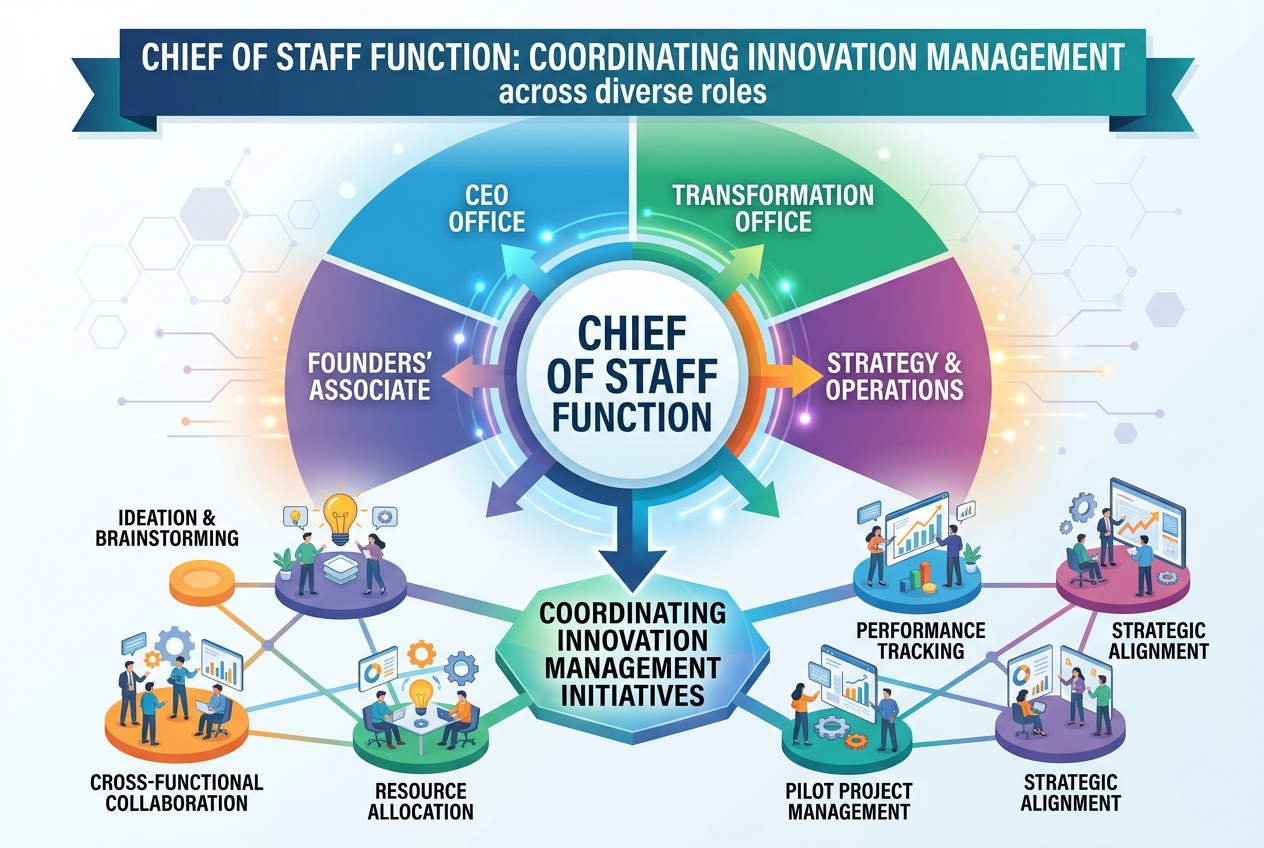
The confusion is amplified by the fact that similar assignments bear many different names. In some organizations, they are called Chief of Staff, while others use designations such as CEO Office, Founder’s Office, Founder’s Associate, Strategy & Operations, Business Operations, Strategic Projects, Executive Business Partner, Head of Special Projects, Business Manager to CEO, Transformation Office, or Office of the CEO. Despite the variations, the assignment often revolves around the same fundamental challenge: creating direction, coordination, and execution power.
At the same time, expectations of corporate management are changing rapidly. Digitalization, AI, sustainability requirements, ESG reporting, change programs, and innovation initiatives compete for management attention. Many CEOs and management teams are discovering that the business no longer lacks strategies. The problem is rather coordination, prioritization, and execution. Therefore, it is time to ask the question seriously: should the Chief of Staff be seen as an individual position with a clear mandate or as an organizational function that can encompass multiple people, processes, and competencies? The answer is more nuanced than many believe, and the choice can have great significance for the organization’s ability to navigate an increasingly changing environment.
When the whole becomes more important than the parts
Organizations tend to create specialists for every challenge. Project managers drive projects. HR is responsible for people. The finance function handles funding. Sustainability managers work with ESG. But who ensures that everything is connected? There is an old insight that is particularly relevant for the Chief of Staff role:
”Strategy without execution is hallucination.”
Thomas Edison
The quote captures the essence of why the Chief of Staff has emerged as a central component in modern organizations. Strategic plans have limited value if they are not coordinated across organizational boundaries. Similarly, well-executed initiatives can have limited value if they are not linked to a common direction. Sometimes the simplest observations hold the deepest wisdom. When management teams pause and reflect on why important change initiatives are delayed or why strategic investments falter, the same answer often recurs: there is no natural owner of the coordination between functions. Chief of Staff therefore does not primarily deal with control or administration. It is about creating clarity in complexity. When someone takes responsibility for the whole, it becomes easier for specialists to succeed in their respective fields. And when the whole works, the organization’s ability to adapt to future changes is also strengthened.
Chief of Staff as a role, function or both?
When analyzing the Chief of Staff concept in more detail, two clear perspectives emerge:
Arguments for making the Chief of Staff a role
Det vanligaste synsättet är att Chief of Staff är en individuell roll med en specifik befattningshavare. Personen arbetar ofta nära VD, koncernchef eller grundare och fungerar som en strategisk partner i ledningsarbetet. Fördelarna med detta synsätt är flera. För det första skapas ett tydligt mandat. Organisationen vet vem som ansvarar för koordinering, uppföljning och prioritering av tvärfunktionella initiativ. För det andra byggs förtroendefulla relationer med ledningsgruppen. En framgångsrik Chief of Staff utvecklar djup förståelse för både verksamhetens möjligheter och utmaningar. Detta gör det möjligt att agera rådgivare snarare än administratör. För det tredje ökar handlingskraften. När ansvar koncentreras till en person blir beslutsvägarna kortare och aktiviteter kan genomföras snabbare. Nackdelen är att rollen ibland blir alltför personberoende. Om organisationen är starkt beroende av en enskild individ riskerar viktig knowledge, relationer och arbetssätt att försvinna när personen lämnar företaget.
Arguments for making the Chief of Staff a function
Another perspective is to view the Chief of Staff as an organizational function. This approach is becoming increasingly common in larger or rapidly growing organizations where the needs extend far beyond a single individual. In practice, the function’s responsibilities may include:
• Strategic planning
• Project and portfolio management
• Change management
• Innovation management
• ESG and sustainability initiatives
• Management team support
• Business transformation
• AI and digitalization initiatives
• Communication coordination
Here, terms like Transformation Office, CEO Office, Office of the CEO, Strategy & Operations or Business Operations become relevant. Instead of focusing on the individual, the focus is on the capacity that is built around the leadership. The benefits are significant: The function becomes less personally dependent. Processes can be standardized. Competencies can be combined. The organization gains a stable structure to drive change over time. At the same time, there are risks. For many processes, this can create bureaucracy. If the function does not have a clear mandate, it can be perceived as yet another layer between management and operations.
Why the different names actually describe the same need
An interesting observation is that the many alternative titles often arise based on the organization’s maturity and culture. Start-up companies often use Founder’s Associate or Founder’s Office because the founder is still the central hub of the business. Growth companies often prefer Strategy & Operations or Business Operations because the focus is on scaling and operational efficiency. More established companies often use Chief of Staff, Office of the CEO, or Transformation Office to signal strategic management support and cross-functional coordination. Regardless of the title, however, it comes down to the same fundamental problem: the organization’s increasing complexity requires someone who works cross-functionally and on a long-term basis.
The Chief of Staff of the future
Perhaps the most important development is that the role is increasingly evolving from administrative support to a strategic change engine. Historically, the role could sometimes be reduced to meeting coordination and follow-up. Today’s Chief of Staff works rather to orchestrate transformation. When organizations introduce AI, implement sustainability initiatives, establish innovation programs, or drive comprehensive change projects, someone is needed to ensure that the activities work together rather than competing for resources. In this way, the Chief of Staff often becomes the cohesive link between strategy and implementation.


Perhaps the question is phrased incorrectly?
After analyzing the arguments for both the role and function, an interesting conclusion emerges. Perhaps the question of whether the Chief of Staff is a role or function is actually misdirected. In smaller organizations, the Chief of Staff is often a role. A person serves as the CEO’s extended arm and coordinates strategic initiatives. In larger organizations, the same duties gradually evolve into a function. More competencies are needed to manage project portfolios, transformation, innovation, sustainability, and business development. Therefore, the decisive factor is not the organizational structure but the purpose. If the ambition is to improve coordination, increase the pace of change, and create better execution capabilities, the organization needs some form of Chief of Staff capacity. The title is secondary. What really matters is that someone takes responsibility for what otherwise risks falling between the cracks: the interplay between strategy, people, processes, and change.
Chief of Staff as the organization's integrating force
The biggest challenge for modern organizations is rarely a lack of ideas. The challenge is to turn those ideas into results in an environment characterized by complexity, rapid change, and many parallel initiatives. From that perspective, the discussion about the Chief of Staff is less important than the underlying question: does the organization have the capacity to coordinate its change efforts? A single Chief of Staff may be the right solution in a smaller or medium-sized organization. A broader function such as the CEO Office, Transformation Office, Strategy & Operations, or the Office of the CEO may be more appropriate in larger organizations. Often, the evolution is natural. It starts with one person and over time builds a function around the same mission. For CEOs, CFOs, and management teams, the real insight is that the Chief of Staff is not primarily about a title. It is about establishing an organizational hub for coordination, prioritization, and execution. As the pace of change increases, the need for such a hub becomes increasingly important. Organizations that succeed in creating this capability not only gain better control over their initiatives; they also build a stronger ability to adapt, innovate, and deliver results over time. Perhaps that is why the most accurate description of the Chief of Staff is this: not a role or a function, but the organization’s integrative force between strategy and reality. That is where the real value arises.

