


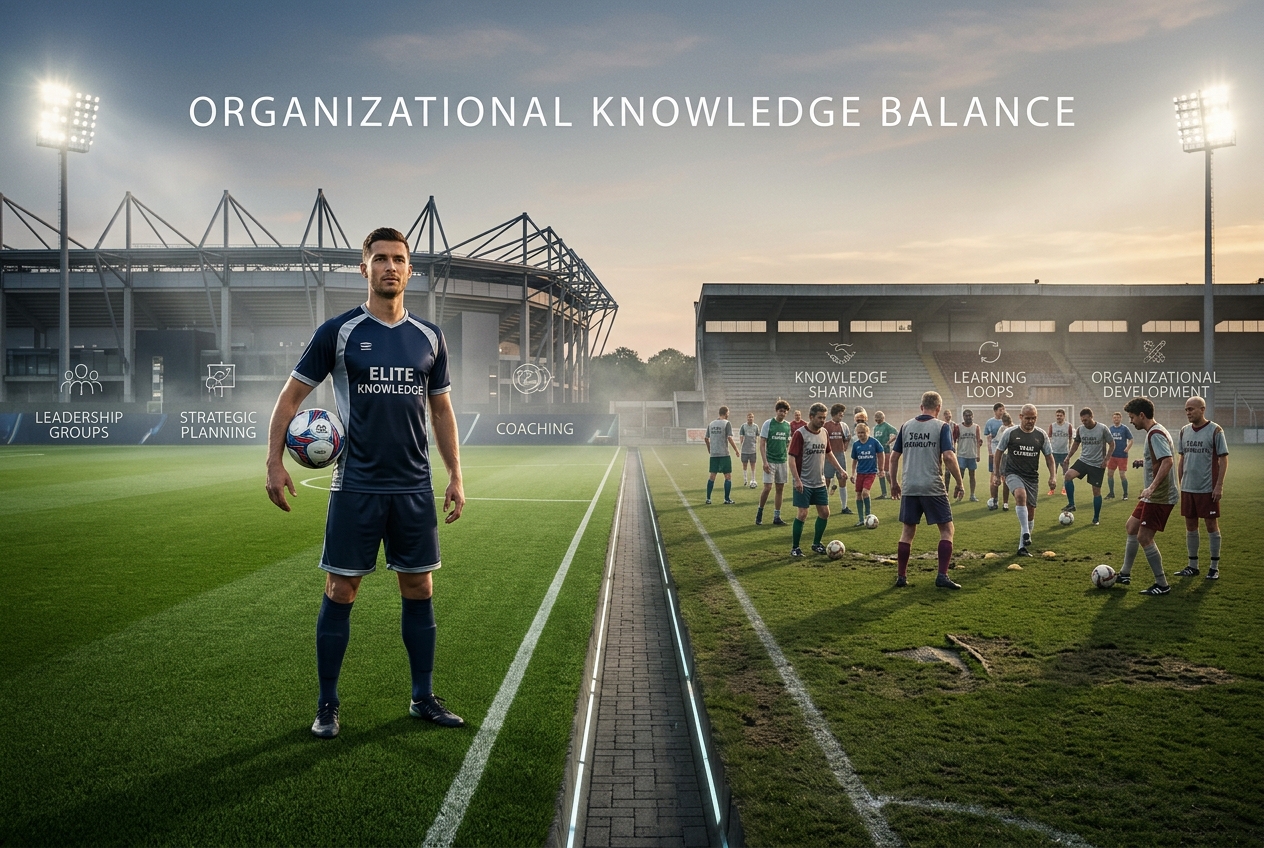
An experienced project manager, a skilled change leader, or a strong consulting team can create momentum in an organization. But what happens when the expert leaves? If the results disappear with the person, we need to ask ourselves what the organization has learned. This article explores the difference between borrowing skills and building shared capabilities. Using the football team as a metaphor, the focus is on four knowledge balances: Ambition and capacity, leadership and organization, individuals and teams, as well as delivery and learning. The perspective shifts the focus from who should drive the change to what conditions need to exist for it to endure. Here, we discuss how a Chief of Staff can act as a capacity architect and link strategic ambitions with day-to-day implementation. The starting point is not that expertise lacks value; rather, its value needs to continue to live on in the organization’s working methods. The crucial question therefore becomes: How do we build an organization that not only helps it perform, but also learns to perform together in order to play in a higher dimension?
When the organization is not ready for the expert
Why project managers, change leaders and consultants often fail despite actually doing the right thing
There is a question that organizational leaders rarely ask when faced with a major change: Is the organization actually ready for the expertise we intend to bring in?
Instead, the discussion often starts at the other end, when a transformation is slow in progress, a strategic initiative is losing momentum, or an important development project seems to have stalled. The management analyzes the situation and concludes that the organization needs more experience, better methodology, or stronger leadership, which leads to the hiring of an experienced project manager, the engagement of a change leader, or the involvement of a consulting team. During a period, things often look promising, as meetings become more structured, plans are drawn up, and problems are identified, while reporting improves and progress becomes visible. Despite these advances, something strange happens when the expert leaves the organization: the pace slows down, old behaviors return, and the problems that were supposed to be solved reappear. The management then starts to wonder why the expected effect did not occur and whether the expert really was the right person for the assignment. However, often it is not the choice of expert that is the problem, but the organization’s own ability to receive, absorb, and translate the expertise represented by the expert. This is where many transformation initiatives go wrong, even before they have even begun.
The football team that signed a star player
Imagine a football team in one of the lower divisions, where the players are committed and want to win, but occasionally, despite their aspirations to develop, they still train. The team management decides to sign a player from the top division, and the results are immediately visible when the new player scores many goals and the team starts winning matches that previously ended in a draw. Both the audience and the team are satisfied, while the coach feels that the team has taken a big step forward. But if we stop and ask ourselves whether the team has really improved, we also need to consider whether the players have improved their playing perception, whether the training discipline has changed, and whether the technical level of the other team members has increased. Has the team's overall performance improved, or is it primarily the star player's performance that is visible in the results?
It is not certain that the team as a whole has become better, and in fact the opposite can happen when players start relying on the star instead of developing their own abilities. When the star then leaves the team, the same player, the same habits, and the same limitations remain. The same mechanism repeats over and over again in organizations, where the project manager, change leader, or consultant becomes the star that drives the results, without the organization learning to play at a higher level as a result.
The uncomfortable truth about change
Many management teams underestimate the amount of organizational learning required to implement a real transformation, which is understandable given their own perspective. By reading market reports, attending conferences, discussing future issues, and meeting other leaders who have already completed their own transformation journeys, they develop a strategic and forward-looking perspective, where the need for change becomes increasingly clear. In the organization’s day-to-day operations, however, the situation often looks different, as attention is focused on the tasks that must be completed ”here and now”. Customers need to be handled, systems maintained, and budgets kept, while ongoing problems require time and commitment. While management is busy understanding where the organization needs to go, employees are often busy getting the existing operations to function.
What appears to management as a straightforward change may therefore be perceived as something completely different further down in the organization, where the new direction is to be understood and implemented amidst the ongoing work. The difference may not be due to people being reluctant or lacking the will to contribute, but may instead be related to the fact that the conditions for understanding, accepting, and implementing the change have not yet been established. While the management looks to the future, the organization lives in the present, which means that the same change is viewed from two different starting points, creating a gap.
The problem is rarely a lack of skills
When a transformation fails, the diagnosis is often incorrect. It is concluded that:
- project management has been inadequate
- communication has been deficient
- The management has been unclear
- The leadership for change has been too weak
Sometimes that is true, but often there is a deeper explanation – the organization lacks a balance between ambition and capacity. The management has decided to play in a higher division than the one it has been training for. The following will happen on the short term:
- The consequence is that the project manager has to compensate for a lack of decisiveness.
- The change leader may have to compensate for weak leadership
- The consultant is allowed to compensate for the lack of internal expertise
- Results can still be achieved
But the organization is not evolving – and that is a crucial difference.
Four knowledge balances that determine the ability to change
If we want to understand why some organizations develop faster than others, we need to shift the focus from the individual to the system. In this text, four knowledge balances are used as a way to examine the organization’s ability to change. By balance, I do not mean that both sides should weigh equally, but that they need to develop in interaction: ambition and capacity, leadership and organization, individual and team, and delivery and learning.
1. The balance between ambition and capacity
The organization having high ambitions but limited ability is perhaps the most common imbalance:
- You want to become data-driven
- They want to introduce AI
- They want to shorten lead times
- We want to increase the ability to innovate
- You want to become more agile
There is nothing wrong with these ambitions, but for them to be realized they need to be accompanied by corresponding investments in skills, learning, governance, and culture. The problem arises when the organization raises its goals without simultaneously developing the ability required to achieve them, as if it were possible to run faster without training harder.
For a brief period it may work, but sooner or later reality catches up and reveals where the organization’s current limitations lie. The ambition therefore needs to be about both what results one wants to achieve and how to build the capacity to achieve them over time.
2. The balance between management and organization
Management teams are often several steps ahead of the rest of the organization in their thinking, which is a natural consequence of their mission. At the same time, this means that they sometimes overestimate how well the organization has understood the change. What appears logical to management can appear confusing to the employees. When this imbalance becomes severe, the organization begins to exhibit classic symptoms:
- passive resistance
- Unclear priorities
- low rate of change
- Lack of commitment
Management often interprets this as a reluctance to change, while in reality it often involves understanding.
3. The balance between the individual and the team
Many organizations invest heavily in individual development by training employees, conducting certifications, and recruiting specialists who bring new knowledge. These are important investments, but the organization’s performance is determined not only by what each individual can do, but also by how that knowledge is utilized in the teams’ collective work. A group of highly competent individuals therefore does not automatically constitute a high-performing team, just as a football team does not become a champion solely by assembling star players. For the individual knowledge to contribute to the organization’s success, it needs to be translated into collaboration, coordination, and common working methods, so that the different abilities of people strengthen each other.
The balance between the individual and the team therefore involves developing both people's own competencies and their ability to use them together with others. Real performance arises in the interaction between people, where knowledge becomes a shared asset rather than something that remains with the individual.
4. The balance between delivery and learning
The balance between delivery and learning is perhaps the most underrated of the four knowledge balances, because most organizations reward what is delivered but rarely pay attention to the learning that makes future deliveries possible. When the emphasis is on solving today’s problems, it becomes easy to prioritize the immediate results over the development of tomorrow’s capabilities. In the short term, this may seem effective, but in the long term the organization risks stagnating as work continues without the development of shared capabilities. The challenge is therefore not to choose between delivery and learning, but to give both space so that today’s work also contributes to tomorrow’s capacity. Just as elite athletes, organizations that want to develop over time need to make training an equally integral part of the business as the actual performance itself. No one expects a football team to win a championship without training in between matches, but in organizations there is still often an expectation that the ability to change will grow without allocating time for learning. It is a contradiction: if the organization is to perform at a higher level, it also needs to be given the space to develop the necessary ability.
What can be done? One way to test readiness is to have the four balances become four questions before the next initiative:
- What capacity do we need to build in order for the ambition to be reasonable?
- What do management and employees need to understand about each other’s circumstances?
- How should the expert's knowledge become part of the team's common working methods?
- What space do we allocate for learning while delivering it?
The answers can highlight what needs to be developed before and during the change, not just who should drive it.
Chief of Staff as the organization's capacity architect
The role of Chief of Staff becomes particularly interesting here, because the traditional description of a strategic coordinator, advisor, or extension arm of the leadership only captures part of the task I envision. In an era where the pace of change is increasing, I believe the role needs to evolve to also be the organization’s capacity architect, focusing on connecting the leadership’s ambitions with the organization’s ability to realize them. This means continuously helping the leadership understand the difference between ambition and capability and identifying when the organization is trying to run faster than its current capacity allows. The task also includes identifying the dependencies that risk hindering a transformation and creating structures for organizational learning, so that the organization not only undertakes new tasks but also develops the ability to handle them.
An important part of the role therefore becomes asking the questions that many management teams risk otherwise missing: Is the organization ready for this change, and what capacity needs to be built before the next step can be taken? What behaviors need to be changed, and what must the organization train on before it is reasonable to expect new results? A skilled Chief of Staff thus not only helps the management make decisions, but also the organization develop the ability to implement them. This is a crucial difference, because the task then does not stop at coordinating what needs to be done, but also includes building the shared capacity that makes implementation possible.
The most important question ahead of the next transformation
When the next major change initiative is presented, the management team might not start by asking:
”Who should lead this?”
Instead, one should start with another question.
”Are we prepared to become the organization needed to succeed?”
If the answer is no, the solution is rarely to recruit another expert. The solution is to develop the organization’s overall capacity. Because organizations, just like football teams, do not win in the long term through a single star player. They win by the entire team learning to play at a higher level, which is perhaps the most important insight of all.
The real transformation challenge is not about finding the expert; it's about building an organization that can become an expert together.
Read more about organizational knowledge balance here->

