


The organization of the future: When value creation replaces silos
What will an organization with 1,000 employees look like in ten years? Will we still recognize today’s organizational structure with HR, IT, finance, marketing, and production as separate units, or are we facing a completely new way of organizing work? Technological developments, with artificial intelligence, automation, and data-driven decision-making at the forefront, challenge many of the principles that governed organizations over the past century. At the same time, the demands for rapid adaptation, innovation, and efficiency are increasing in both the private and public sectors. This makes traditional silos increasingly perceived as obstacles rather than enablers. The organization of the future will most likely not be built around functions but around value-creating flows, cross-functional teams, and digital employees. Specialist competencies will still be crucial, but they will operate in new forms where collaboration, adaptability, and strategic coordination become key success factors. In this development, the need for roles that can create direction, coordination, and execution power in an increasingly complex reality is also growing. The question is therefore not whether the organization will change, but how it can best lead through the change.
The organization of the future in 2035: Is the end of HR, IT and finance as separate silos?
From organizational chart to capability network
Many management teams today ask the same question: how do we organize ourselves when artificial intelligence, automation, and constant change become the norm rather than the exception? Over the past hundred years, most organizations have been built according to the same basic principle. We have divided our operations into functions such as HR, finance, IT, marketing, sales, and production. The model has served us well because it has created clarity, specialized expertise, and control. But the world that created the classic organizational structure is undergoing fundamental change. As information moves instantaneously, AI can perform large parts of administrative work, and customers, citizens, and employees expect faster decisions, functional silos are increasingly becoming a brake. The question is therefore not whether organizations will change, but how quickly.
In an organization with 1,000 employees, the focus will likely shift from functions to capabilities. Instead of asking who owns a process, management will ask what capacity is needed to solve the task. Many of today’s support functions will still exist, but their role will change dramatically. At the same time, the need for coordination is increasing. As boundaries between functions blur, someone is needed who sees the big picture, drives transformation, and ensures that strategic initiatives actually deliver results. Here, the role of the Chief of Staff emerges as a central enabler for the organization of the future. The big change is therefore not about HR, IT, or finance disappearing. It is about the organization moving from fixed boxes on an organizational chart to a dynamic network of competencies, teams, and digital employees.
About the organizations and leadership of the future
The American management theorist Peter Drucker is said to have said:
”The greatest danger in times of turbulence is not the turbulence itself, but to act with yesterday’s logic.”
Few quotes describe the future organizational challenge better than this. Historically, organizations have been optimized for stability. Successful organizations of the future will instead be optimized for adaptability. There is an old sailing wisdom that says that you cannot control the wind, but you can adjust the sails. The same principle applies to management and leadership. No management team can control technological developments, new business models, or changing citizen needs. However, one can create an organization that can respond quickly to change. Many managers still focus on structure. But the competitive advantage of the future will to a greater extent be about coordination. The ability to get people, technology, and processes to move in the same direction will become more important than the organizational chart itself. This is why the shift towards more network-based organizations is not primarily a technical issue. It is a leadership issue. The more complex the external environment becomes, the greater the need for people who can create connections between strategy and implementation.
The organization model of the future: AI-centric, network-based, and driven by change
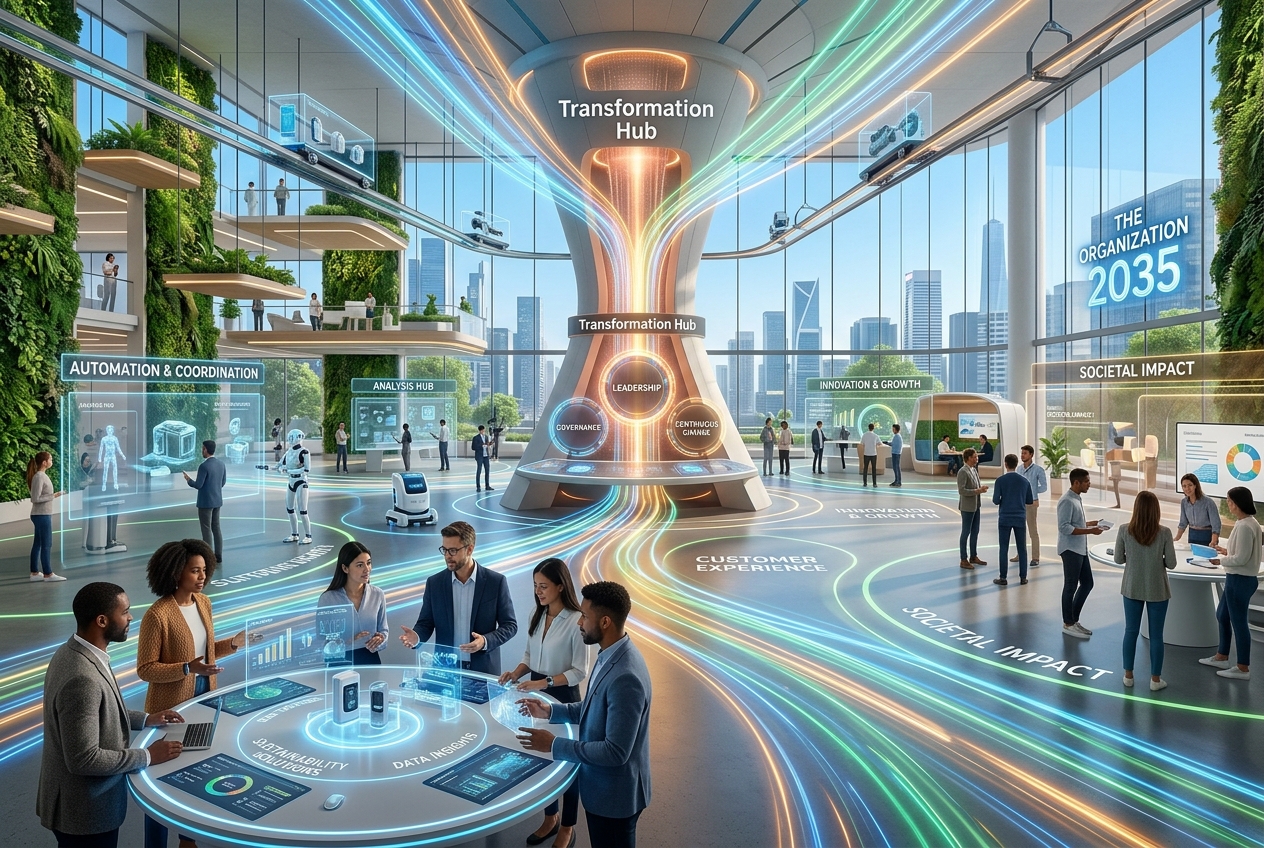
Let us imagine a public administration or a private organization with about 1,000 employees in 2035. The first thing that will probably surprise us is that the organizational structure still exists. People need division of responsibilities, decision-making mandates, and leadership even in the future. However, the organizational structure will no longer be the primary mechanism for how work is performed. Instead, the organization will be organized into three layers.
Layer 1: Automated support functions
Today's HR, finance, and IT departments will be highly automated. AI agents will handle recruitment administration, ongoing financial reporting, budget tracking, support cases, and large parts of internal service. This does not mean that expertise is disappearing. On the contrary, specialist knowledge will become even more important. The difference is that many routine tasks are eliminated. An accounting function that today consists of 40 people may in the future consist of 15 people working on analysis, business management, and strategic decisions while AI systems carry out the majority of transactions. The same development awaits HR. The focus is shifting from administration to organizational development, talent acquisition, and culture.
Layer 2: Cross-functional value flows
Core operations are increasingly organized around value-creating processes rather than functions. An example might be:
- Customer experience
- Product development
- Citizens' Service
- Sustainable transformation
- Digital innovation
Each value stream is staffed with expertise from multiple disciplines. Economists, HR specialists, data analysts, lawyers, and business experts work together towards common goals. In practice, this means that employees can belong to a professional expertise community while being placed in a cross-functional delivery team. The model already resembles the way many successful technology organizations operate today, but it is likely to spread far beyond the IT world.
Layer 3: Transformation as a permanent ability
The third component is perhaps the most crucial. Historically, change projects have been temporary initiatives. In the future, change will be a constant state. Organizations will therefore need to build a permanent capacity for change. This creates a new organizational center. Instead of driving transformation through individual projects, a strategic hub is often established consisting of:
- Chief of Staff
- PMO or transformation offices
- Innovation management
- Sustainability management
- Data and AI management
- Change management
This hub ensures that the organization moves in step with strategic goals. When the number of initiatives increases, the organization otherwise risks getting stuck in a state of constant activity without actual movement. Many management teams already recognize this. Ideas are rarely lacking. What is lacking is coordination. The Chief of Staff role is therefore becoming increasingly important. The role serves as the link between strategy, leadership, and execution. As the organization becomes more network-based, the need for someone who can see the big picture and translate vision into action increases.
What happens to the middle managers?
A common question is whether AI will eliminate middle managers. Probably not. However, their roles will change. Less time will be devoted to reporting, resource planning, and follow-up. More time will be devoted to coaching, coordination, skills development, and strategic support. Leadership will become less administrative and more human.

Therefore, new technology alone is not enough; new coordination is also necessary.
It is easy to believe that the future of organizational change mainly revolves around AI. But technology is actually the simplest part of the transformation. The real challenge is creating interaction between people, processes, and technology. The more automated decision-making systems that are introduced, the more important governance, prioritization, and coordination become. This is where many organizations will fail. They invest in technology but underestimate the need for cohesive leadership. The future winners will not necessarily be the organizations that have the most advanced AI. They will be the organizations that best combine human judgment with technological capabilities. To succeed, structures are needed that make change possible without creating chaos. People who can navigate between strategy, operations, and execution are also required. This is where the role of the Chief of Staff becomes particularly relevant.
Conclusions on the organization of the future: Fewer silos, more coordination
The classic organizational structure is not likely to disappear entirely. HR, IT, finance, and other specialist areas will also be needed in the future. However, their function will change from being independent silos to becoming competence platforms that support cross-functional value flows. The organization in 2035 will likely be characterized by:
- Fewer administrative roles through AI and automation.
- Stronger focus on cross-functional teams.
- Permanent change management instead of temporary projects.
- Data and AI management as a central management issue.
- More coaching leadership.
- Increased need for coordination between initiatives and operational areas.
Paradoxically, more decentralization also means a greater need for centralized coordination. When people, AI agents, and cross-functional teams work in parallel, someone is needed to ensure that everyone is moving toward the same goal. That is why the organization of the future will not primarily be defined by its technology or its structure. It will be defined by its ability to coordinate change. It is here that the Chief of Staff becomes one of the most strategically important roles in the leadership team. The real question, therefore, is not whether HR, IT, or finance will remain. The real question is: who ensures that the entire organization develops as a coherent system as the pace of change continues to accelerate? This is a question that every CEO, general director, and leadership team should begin answering today.
Read more about organization 2035 here->

