


Why successful organizations must master both perspectives
In an era where organizations are subjected to constant change, increasing complexity, and ever-increasing demands for results, the mission of leadership has become more multifaceted than ever before. Many management teams are intensely focused on efficiency, process improvement, and operational excellence. Others focus their attention on strategy, innovation, and future market positioning. But the truly successful organizations understand that these perspectives are not opposites but two sides of the same coin. In the literature on leadership, we often talk about the difference between doing things right and doing the right things. The first concerns quality, efficiency, and the ability to carry out activities in a consistent and controlled manner. This can be linked to the organization’s inherent or so-called intrinsic values, where the focus is on how the work is performed. The second is about choosing the right priorities, investing resources in the right initiatives, and ensuring that the organization is moving in the right direction. This ties into extrinsic values, where the focus is on the value created for customers, owners, employees, and society.
The problem is that management teams often lean too far in one direction. Organizations obsessed with efficiency risk optimizing processes that no longer create value. At the same time, organizations that focus solely on visions and strategic ambitions may lack the ability to deliver results in practice. Here, the role of the Chief of Staff (CoS) becomes particularly important. The CoS acts as the cohesive force that connects strategy with execution, innovation with structure, and long-term goals with operational discipline. By creating transparency, coordination, and shared priorities, the CoS helps management not only to do things right but also to ensure that the organization is doing the right things.
When efficiency meets relevance
The American management thinker Peter Drucker formulated one of the leadership insights that are most often quoted:
”There is nothing so useless as doing efficiently that which should not be done at all.”
The quote captures the essence of the challenge many organizations face. Being effective is not enough if you work on the wrong things. At the same time, the best ideas become useless if the organization lacks the ability to translate them into concrete results. There is timeless wisdom in understanding that success is not about choosing between efficiency and relevance. It is about balance. Just as a ship needs both a captain who sets the course and a crew who ensures that the machinery works, modern organizations need both strategic direction and operational excellence. When leaders pause and reflect on their priorities, an important question often arises: Are we putting most of our energy into improving what we already do, or into evaluating whether it is still the right thing to do? In these moments, real organizational maturity emerges. Only when leadership is able to manage both perspectives simultaneously can the organization build long-term competitiveness and sustainable success.
Intrinsic and extrinsic values from a Chief of Staff perspective
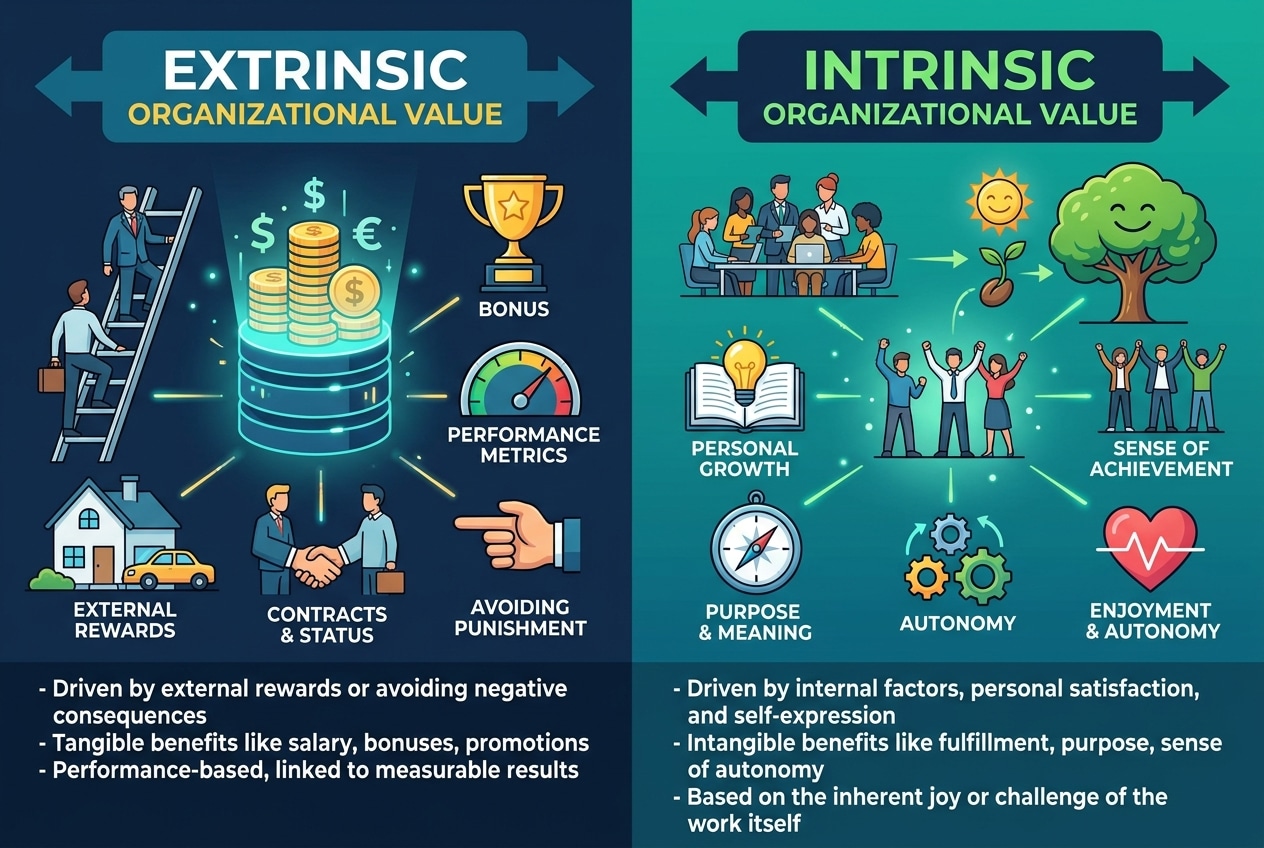
The concepts of intrinsic values and extrinsic values can be described as two complementary dimensions of organizational value creation. Intrinsic values focus on the internal quality of the organization’s work. This involves processes, methodology, governance, quality control, follow-up, and competency development. Organizations that succeed well in this area often build strong structures where decision-making, implementation, and learning occur systematically. Extrinsic values, on the other hand, focus on the external outcome. The questions become instead:
• Are we creating the right value for the customer?
• Do our initiatives contribute to the company's strategic goals?
• Are we preparing the organization for the future market?
• Are we creating long-term sustainability and competitiveness?
From a leadership perspective, this means two completely different types of questions. When a CFO analyzes cost efficiency, they often work from an intrinsic perspective. When the same management team discusses a new business model or an ESG strategy, they instead move towards an extrinsic perspective. However, that does not mean the perspectives are separate. On the contrary, the greatest successes arise when they are integrated. A common example is digitalization initiatives. Many organizations invest significant resources in digital tools to streamline existing processes. The projects can be technically well-executed, have high user acceptance, and deliver against the budget. Viewed from an intrinsic perspective, the project is successful.
But if the market changes at the same time and the needs of customers evolve in a different direction, the organization may have become more efficient at something that is gradually losing its value. Things have been done right but not necessarily the right things. The opposite problem is at least as common. Leaders identify new market opportunities, sustainability initiatives, or innovation programs that are strategically entirely correct. The vision is clear and the direction attractive. But if the organization lacks structure, division of responsibilities, and follow-up, the results are limited. The right things have been identified but the implementation fails. The Chief of Staff role often arises as a solution to this challenge.
A CoS rarely works solely with strategy or solely with operations management. Instead, the role acts as a bridge between these worlds. By coordinating priorities, creating decision-making support, and ensuring organizational coherence, a CoS can help management bridge the gap between direction and execution. In practice, this means that a CoS continuously asks two types of questions:
Questions about doing things the right way
• Do we have the right processes?
• Are responsibilities clearly defined?
• Do we have the right governance model?
• Do we follow up on our results?
• Is there the capacity to implement the change?
Questions about doing the right things
• Is this still strategically relevant?
• Does the initiative support our long-term goals?
• What does the market demand?
• What values are created for customers and stakeholders?
• Should we prioritize differently?
This dual lens is particularly important in today's pace of change. Historically, companies could create competitive advantages through efficient processes for extended periods of time. Today, technologies, customer needs, and regulatory requirements change so quickly that even the most well-organized organization risks becoming irrelevant if it focuses too much on internal optimization. At the same time, innovation without structure rarely has any long-term impact. The real competitive advantage arises when the organization develops the ability to continuously evaluate both efficiency and relevance. This is where the Chief of Staff can create significant value by serving as the management's navigator at the intersection between operations management, change management, and strategic development.


Strategic coordination that creates organizational balance
Many leaders feel that their organization is either too operational or too strategic. Either the discussions are dominated by budget follow-ups, resource planning, and process improvements, or the agenda is occupied by visions, transformations, and future-oriented issues. The challenge lies not in choosing one side or the other. The challenge lies in creating a coherent system where strategy and execution mutually reinforce each other. An important task for the Chief of Staff is therefore to establish connections between the management team’s decisions and the organization’s day-to-day work. When strategic goals are translated into concrete initiatives, clear responsibilities, and measurable results, a cohesive thread is created throughout the entire organization. This is also where many change initiatives succeed or fail. Not because of a lack of vision or competence, but because of the lack of coordination between choosing the right direction and ensuring its implementation. The balance between intrinsic and extrinsic values thus does not become a theoretical leadership issue but a practical leadership ability that must be built and maintained over time.
Chief of Staff as the bridge between efficiency and future value creation
The best organizations are not driven solely by efficiency or visions. They are driven by the ability to combine both. Doing things right creates stability, quality, and predictability. Doing the right things creates growth, innovation, and long-term relevance. Without the first, chaos ensues. Without the second, stagnation occurs. For management teams, the crucial question therefore is not which perspective is most important. The question is how the organization can develop the capacity to manage both simultaneously. Here, the Chief of Staff represents a strategic reinforcement of leadership. The role contributes structure without limiting innovation, creates governance without reducing operational agility, and ensures that strategic ambitions are translated into operational results. In a world where change has become the normal state of affairs, the need for this cohesive function becomes increasingly evident. Organizations that succeed in building bridges between intrinsic and extrinsic values not only achieve higher efficiency. They also develop the ability to continuously create value in a changing environment. And perhaps that is precisely where the greatest challenge of leadership lies: ensuring that every day the organization does both the right things and does things right. It is at the intersection between these two perspectives that truly sustainable success is created.
Read the article in the New York Times about the Chief of Staff->

