



The balance between today's results and tomorrow's renewal
In many management teams, there is now a pronounced ambition to be more innovative. New business models are to be explored, digitalization is to be accelerated, AI is to be implemented, and sustainability initiatives are to be integrated into the business. At the same time, an undeniable reality remains: companies do not make money from tomorrow’s innovations today. Profitability is created by what the organization delivers here and now, through existing products, services, processes, and customer relationships. This is where one of our time’s most underestimated management challenges arises. How do we ensure that the organization can both deliver high efficiency in today’s operations and simultaneously develop tomorrow’s opportunities? Too much focus on innovation risks creating visions without results. Too much focus on operational efficiency risks making the organization irrelevant as the surrounding world changes.
The term organizational ambidexterity * describes precisely this ability to handle two seemingly contradictory tasks simultaneously. The organization must be able to exploit what already works while at the same time evaluating/challenging what might work in the future. It is not a choice between innovation and execution. It is about succeeding in both. In this context, the role of the Chief of Staff is becoming increasingly important. When change becomes permanent and innovation can no longer be organized as a temporary project, someone is needed who can help the leadership navigate the tension between the future and the present. The Chief of Staff becomes the function that ensures that the organization’s strategic development does not come at the expense of today’s achievements, while at the same time today’s achievements do not stifle tomorrow’s possibilities. As innovation and change become a natural part of everyday life rather than an exception, this balance will evolve from a competitive advantage to a survival skill.
Leading between vision and everyday life
There is an old insight in leadership that is often forgotten in times of rapid change: it is easier to dream about the future than to deliver in the present. At the same time, it is at least as risky to be so preoccupied with today's successes that we miss tomorrow's opportunities. Many organizations oscillate between these extremes. During some periods, the innovation agenda dominates. Workshops, pilot projects, and visions fill the calendar. During other periods, sales, cost control, and operational efficiency take over all attention. The problem is that neither extreme creates long-term success. As management scholar Peter Drucker put it:
”The greatest danger in times of turbulence is not the turbulence itself, but to act with yesterday’s logic.”
The quote captures the essence of the ambidextrous challenge. Organizations must dare to think differently, but they must also create value today. The future is not built through ideas alone. It is built through disciplined execution of the right ideas over time. For a Chief of Staff, this means constantly reminding the leadership that strategic development and operational excellence are not competitors. They are interdependent. One without the other sooner or later leads to stagnation or chaos.
Chief of Staff as a facilitator of ambidextrous leadership
Although the concept of ambidextri has been present in organizational research for several decades, surprisingly little has been written about how this is translated into management practices. Even less attention has been paid to the role a Chief of Staff can play in enabling this balance. Traditionally, many companies have viewed innovation as something that takes place outside of the normal business operations. They create innovation programs, appoint innovation managers, or implement specific change initiatives. The problem with this approach is that innovation becomes an episodic rather than a continuous capability. In today’s changing market, this model no longer works particularly well. Technological developments, customer expectations, sustainability requirements, and geopolitical changes continuously impact the business. Change has become the norm. This means that the management team must be able to manage two time horizons simultaneously:
The first time horizon It is about securing today's business. Here the focus is on efficiency, quality, customer satisfaction, profitability and operational stability. This is where the organization's revenue is generated. This is where wages are paid, investments are financed and shareholder value is created.
The second time horizon It is about future competitiveness. Here we find innovation, technological development, new markets, changing customer behavior, and strategic renewal. These activities rarely generate immediate returns. On the contrary, they often require investments that can temporarily strain the results.
The challenge arises because both perspectives compete for the same resources, the same management attention, and the same organizational energy. The operational business always screams loudest! When a customer threatens to leave, a project is delayed, or a quarterly result looks weak, it is natural for the management’s focus to be directed towards the immediate issue. The future value of innovation is then often invisible compared to today’s problems. At the same time, an overly innovation-driven management can create an organization that constantly runs towards the next initiative without ever realizing the effects of the changes that have already been decided upon. The result is a fatigue with change, prioritization conflicts, and reduced productivity. Here, the Chief of Staff emerges as a central coordinating function.
An effective Chief of Staff helps the management team create structures that enable both perspectives to coexist simultaneously. The role is not primarily about driving innovation or managing operational activities. It is about ensuring that the relationship between these two worlds works. This may involve creating governance models where innovation initiatives are evaluated based on both future potential and organizational feasibility. It may involve helping the management team understand which strategic investments should be protected from short-term cost-saving demands. It may also involve highlighting when the organization’s innovation capacity risks being overwhelmed by too many parallel initiatives. The Chief of Staff thus takes on a role as an organizational integrator. In practice, this means creating balance between four key dimensions:
Strategy and deliveryManagement must be able to think long-term without losing focus on current results.
Innovation and efficiencyNew ideas must be developed while existing processes are optimized.
Change and stability: The organization needs to move forward without losing control and direction.
Investment and profitability: Future opportunities must be financed through today's achievements.
This type of balance becomes particularly important when change is no longer a temporary phenomenon. For many years, change initiatives were organized as separate projects. A new business system was implemented. An organizational change was carried out. A new digital strategy was launched. Subsequently, operations returned to normal operations. Today, there is rarely any clear end to the change. New initiatives are implemented at a rapid pace. Technology development continues. The market is changing. Regulatory requirements arise. This means that the organization can no longer distinguish between change and operations. Change is operations. In this environment, ambidextrous leadership becomes less of a strategic ambition and more of an organizational necessity. And when management needs someone who can hold these perspectives together, coordinate priorities, and ensure that the future is built without neglecting the present, the Chief of Staff becomes an increasingly important partner.

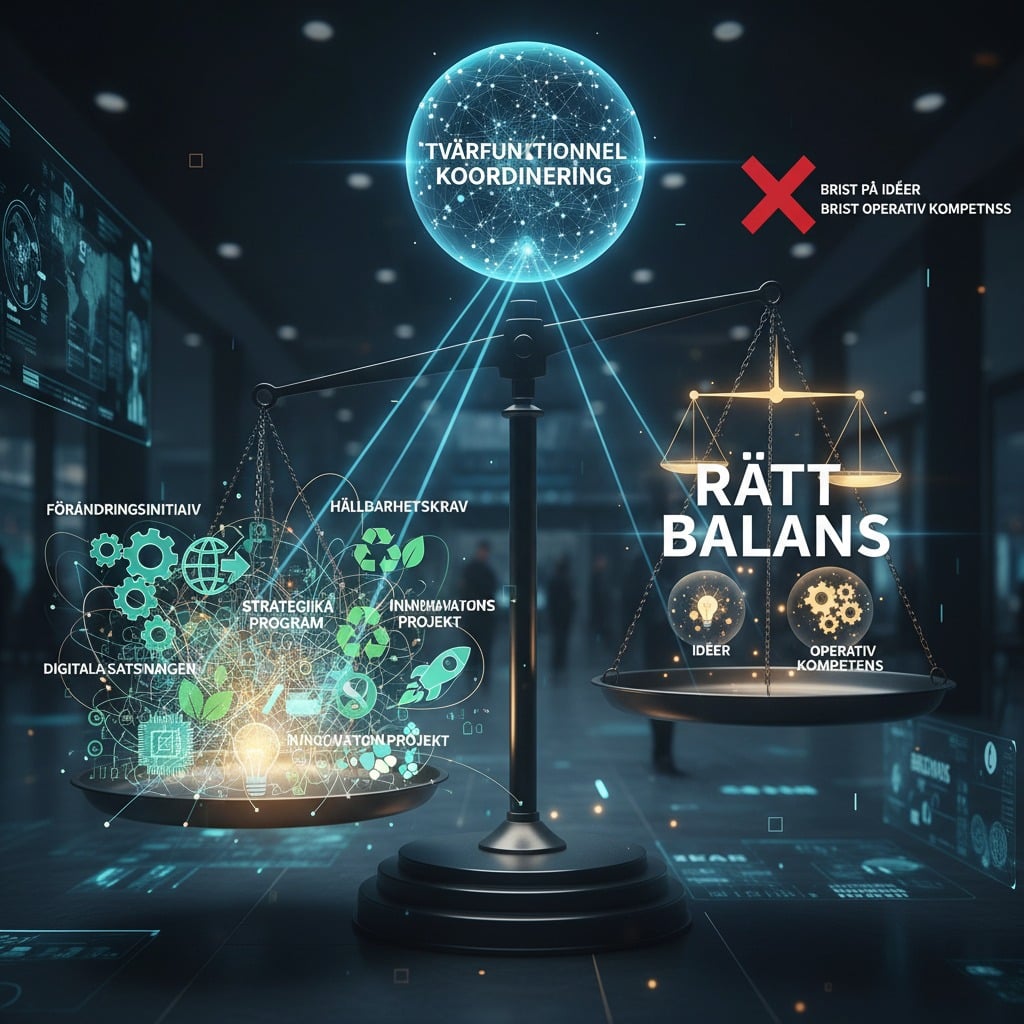
Chief of Staff who bridges the gap between strategy and implementation
A common objection is that organizations already have managers responsible for both operations and development. Why is there then a need for an additional coordinating function? The answer lies in the complexity. The more change initiatives, strategic programs, sustainability requirements, digital investments, and innovation projects that are underway simultaneously, the greater the need for cross-functional coordination. The problem rarely lies in a lack of ideas or a lack of operational expertise. The problem is about creating the right balance between them.
The Chief of Staff serves as the link that ensures that strategic decisions do not remain in presentation materials and that operational priorities do not undermine long-term development. This role contributes to creating an organizational memory, a clearer prioritization logic, and a more sustainable pace of change. It is precisely in this gap between today’s business and tomorrow’s opportunities that the future competitiveness of many organizations will be decided.
The crucial ability: to combine innovation and implementation
Tomorrow's winners will most likely not be the organizations that are most innovative or the most effective. They will be those organizations that succeed in combining both capabilities simultaneously. The real challenge is not in creating innovation. There is plenty of ideas available. The challenge is in creating innovation without weakening the operations that fund the future. Similarly, it is not enough to optimize today's operations if it is done at the expense of tomorrow's relevance. This is where ambidextry becomes a central management perspective. For management teams, it means developing the ability to think in both-and rather than either-or. For the Chief of Staff, it means acting as a catalyst for this balance by creating structures, processes, and decision-making frameworks that make both perspectives visible and manageable.
When innovation becomes a permanent part of the business and change becomes a normal state of affairs, the role of the organizational balancer will increase in importance. The Chief of Staff is not just a coordinator or strategic advisor. The role is increasingly evolving into the facilitator of management for ambidextrous behavior. And perhaps that is exactly what will become the most important competitive advantage of the modern organization: the ability to simultaneously deliver today’s results and build tomorrow’s success. Because in the end, it is not the innovation alone that creates profitability. It is the interplay between innovation and execution that does. That is where value is created. And that is where the Chief of Staff makes its biggest difference.
***
* An ambidextrous approach involves the ability to handle two completely different (and often conflicting) processes simultaneously and with the same skill. The word comes from the medical term ambidextri (to be ambidextrous). In modern management, organizational theory, and leadership, it is used to describe the ability to balance today's stable operations with tomorrow's innovation, i.e., a both-and strategy. Read more here->
Read the article in the New York Times about the Chief of Staff->

